AI Skin Analysis Machines: A 2026 Guide for Indian Clinics
A practical guide to AI skin analysis for Indian clinics, covering 2026 research, clinical limits, buying checks, assessment workflows and investment planning.

Research checked: 23 October 2026. Educational guidance for dermatologists and aesthetic clinic owners.
An AI skin analysis machine can make a consultation more visual, consistent and easier to revisit. Its value depends on what the system actually measures, how reliably it repeats those measurements and how the doctor uses the information. A polished report alone is not a reason to recommend a procedure.
For an Indian clinic considering its next investment, digital assessment deserves a place beside treatment equipment in the buying discussion. The opportunity is a structured consultation and follow-up service: document a baseline, explain the treatment plan and review progress using comparable images. This is a proposed service model, not a promise of additional revenue.
What is changing globally in dermatology AI?
Recent research is examining fairness and the way people interpret AI recommendations, rather than treating headline accuracy as sufficient evidence. A July 2026 study in Scientific Reports explored a method intended to reduce skin-tone bias. Its authors noted that clinical utility and real-world impact still require prospective validation. This is research progress, not validation of every commercial skin analyser. Read the study (https://www.nature.com/articles/s41598-026-59316-x).
An August 2026 Nature Medicine study examined different explanations and decision workflows in AI-assisted dermatology. It illustrates why interface design and human judgment matter alongside the algorithm. Results from controlled image-based experiments should not be assumed to describe routine Indian clinic performance. Read the research (https://www.nature.com/articles/s41591-026-04553-w).
The practical buying lesson is to ask how a particular system was tested, who used it and which patients were represented. Evidence for one algorithm does not automatically support another product carrying an AI label.
Cosmetic analysis and medical diagnosis are different services
A cosmetic imaging system may display appearance-related scores or image comparisons. A diagnostic system makes medical claims that need their own evidence and regulatory assessment. Ask the supplier to identify each output, its intended use and the basis for its interpretation.
Do not assume that a pore, pigmentation or skin-age score diagnoses disease, measures biological ageing or establishes which treatment a patient needs. A concerning lesion requires appropriate clinical assessment. A reassuring cosmetic report should never override a doctor's concern.
In India, CDSCO describes medical devices by their intended purposes, including diagnosis, monitoring and treatment, and its definition includes software. The intended use therefore matters when reviewing a device's regulatory position. Check the exact model, software version, manufacturer and relevant Indian documentation with the supplier and an appropriately qualified regulatory adviser. See CDSCO's medical device information (https://www.cdsco.gov.in/opencms/opencms/en/Medical-Device-Diagnostics/Medical-Device-Diagnostics/).
What service could a clinic add?
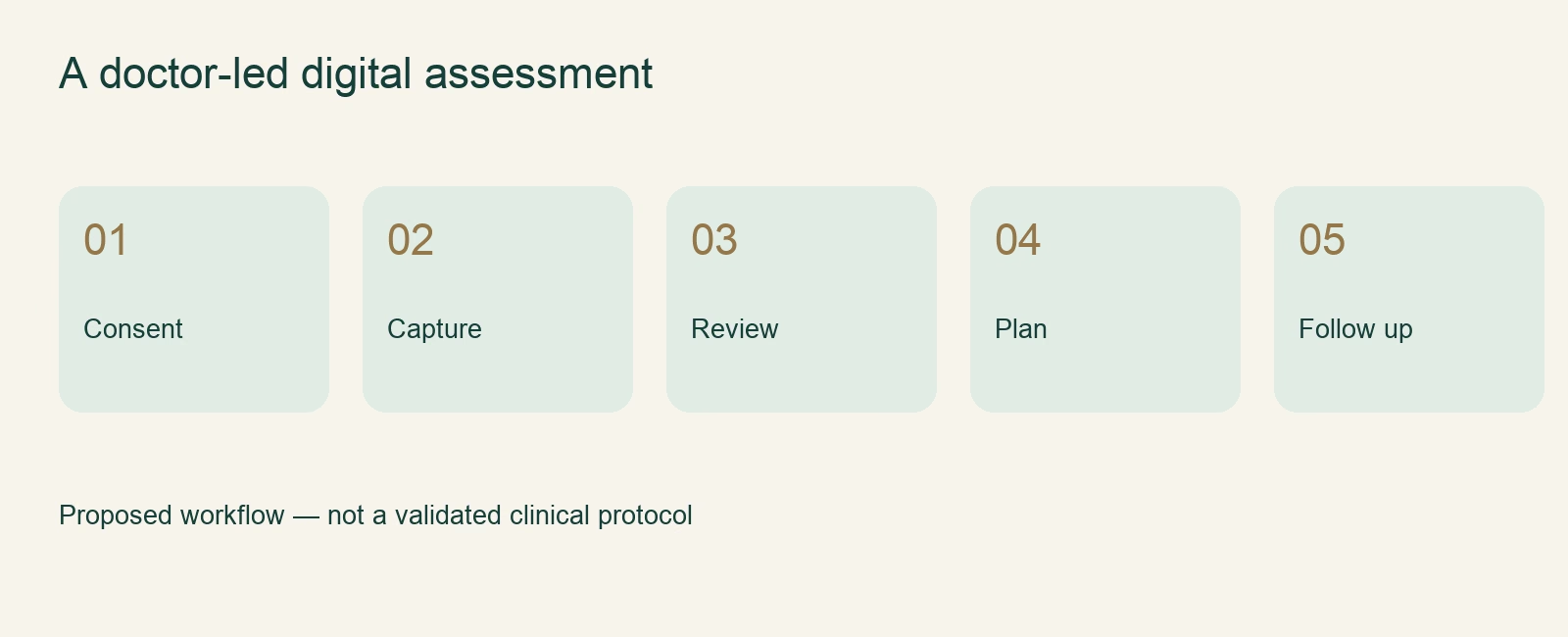
A useful starting point is a doctor-led digital skin assessment appointment. The deliverable should be understandable: a documented baseline, a clinical interpretation, agreed goals and a follow-up plan. Explain what the imaging contributes and what remains uncertain.
For patients already receiving clinically appropriate care, repeat photography can support discussions about progress. Choose follow-up timing according to the condition and treatment plan rather than a generic software recommendation. Avoid presenting every change in a numerical score as a meaningful treatment effect.
A clinic could also improve its existing consultation rather than introduce a separate charge. Compare both approaches during a pilot. Patients should understand any assessment fee before the appointment, and declining imaging should not turn into pressure to purchase treatment.
Questions to ask before buying an AI skin analyser in India
Can the system produce comparable images?
Ask for a demonstration of repeated capture under a written protocol. Review lighting, camera position, facial orientation, image scale and preparation instructions. Request exportable original images, not only a branded PDF. Repeatability should be demonstrated for the outputs the clinic intends to use.
What evidence supports each claim?
Request the study or technical validation for the exact model and software version. Ask which skin tones and age groups were included, whether testing was independent and whether it occurred in routine practice. Diagnostic research about skin-tone bias should prompt scrutiny; it does not establish the performance of cosmetic scores.
What happens to patient photographs?
Ask where images are stored, who can access them, whether cloud processing occurs, how deletion works and whether images are reused for model development. Document a consent process appropriate to the clinic's use. Separate consent for care documentation from permission to use images in marketing.
What support is available locally?
Request a written installation and training plan, service coverage, warranty exclusions, response commitments and software renewal terms. Confirm whether the system remains usable if a subscription ends or internet access fails. A low purchase price may be less attractive if essential exports or support cost extra.
Budget for the complete service
Compare written quotations using the same assumptions. Include the machine, computer or tablet if required, software, installation, taxes, training, maintenance and staff time. Add the cost of secure storage and any supplier-supported calibration or servicing requirements.
Use a simple planning calculation:
Monthly contribution = completed paid assessments × (assessment fee − variable cost per assessment) − additional monthly fixed costs.
Treat this as a budgeting tool. Populate it with the clinic's own fees, quotations and realistic appointment capacity. Include the doctor's interpretation time, and test what happens when volume is lower than expected. If imaging is included within consultations, assess its operational value without inventing a separate revenue stream.
Run a controlled pilot before expanding
Start with a defined appointment type and a small operational pilot. Write down image preparation, capture steps, who reviews the report and how findings are explained. Staff should know when to repeat a poor-quality image and when to escalate a clinical concern.
Track appointment length, image retakes, patient comprehension, export reliability and staff workload. Review whether the service actually improves documentation and decision-making. Do not judge success only by how many procedures are sold after an assessment.
For equipment discussions, Beauty Enrich lists an AI Face Analyser A5 (https://www.beautyenrich.com/products/ai-face-analyser-a5). Use the listing as a starting point for a model-specific demonstration and documentation request. This article does not independently establish that product's clinical accuracy or regulatory status. The wider Beauty Enrich equipment catalogue (https://www.beautyenrich.com/products) can help frame a consultation around the services your clinic plans to provide.
Frequently asked questions
Can an AI skin analysis machine replace a dermatologist?
A cosmetic analyser should be used within its documented intended purpose. Its output does not substitute for history, examination or a doctor's clinical judgment. Any diagnostic claim needs separate, product-specific evidence.
Is an AI skin analyser a sensible first clinic investment?
It may be worth evaluating when documentation and consultation quality are clear priorities. Compare it with simpler photography options and the clinic's other needs before committing. Suitability depends on workflow, budget, support and demonstrable usefulness.
How should clinics assess suitability for Indian patients?
Request evidence relevant to the clinic's patient population, including skin-tone representation, and inspect repeatability during a demonstration. Do not infer local suitability from overseas popularity or the presence of AI branding.
Will this service increase clinic revenue?
That cannot be guaranteed. Test demand and operating costs with the clinic's own data. A useful assessment service should support appropriate care and clear communication, with financial expectations grounded in actual capacity and costs.
Images: The cover is an AI-generated conceptual illustration, not a photograph of a marketed device or an example of diagnostic performance. The additional diagram shows a proposed clinic workflow, not a validated clinical protocol.
Explore the AI Face Analyser A5