Diode Laser Wavelengths Explained: 755, 808/810, 940 & 1064 nm
A practical, evidence-informed guide to 755, 808/810, 940 and 1064 nm diode laser wavelengths—what each contributes, who may benefit, and why wavelength alone does not determine hair-reduction results.
Diode laser platforms are commonly advertised as single-, triple- or quadruple-wavelength systems. The numbers—755 nm, 808 or 810 nm, 940 nm and 1064 nm—describe the wavelength of the light emitted by the handpiece. They affect how strongly light is absorbed by melanin and how deeply it travels through tissue.
But a wavelength is not a result guarantee. Hair reduction also depends on hair colour and thickness, skin type, recent tanning, treatment area, hair-growth cycle, fluence, pulse duration, spot size, cooling, technique and the actual measured output of the machine.
This guide explains what each wavelength contributes and how much practical difference it can make.
𝗙𝗶𝗿𝘀𝘁: 𝘄𝗵𝗮𝘁 𝗶𝘀 𝘁𝗵𝗲 𝗹𝗮𝘀𝗲𝗿 𝘁𝗿𝘆𝗶𝗻𝗴 𝘁𝗼 𝘁𝗮𝗿𝗴𝗲𝘁?
Laser hair reduction relies mainly on selective photothermolysis. Melanin inside a pigmented hair shaft and follicular structures absorbs light and converts it into heat. When enough controlled heat reaches the relevant growth structures, future growth can become slower, finer and less dense.
The challenge is that the epidermis also contains melanin. A useful treatment therefore needs sufficient follicular heating while limiting excessive heat in the skin surface. Wavelength, pulse duration and cooling work together to create that balance.
Dark, coarse hair generally responds more reliably than white, grey, very light blonde or some red hair because it offers more target pigment. No conventional wavelength can reliably compensate for an absence of melanin.
𝗔 𝗾𝘂𝗶𝗰𝗸 𝘄𝗮𝘃𝗲𝗹𝗲𝗻𝗴𝘁𝗵 𝗼𝘃𝗲𝗿𝘃𝗶𝗲𝘄
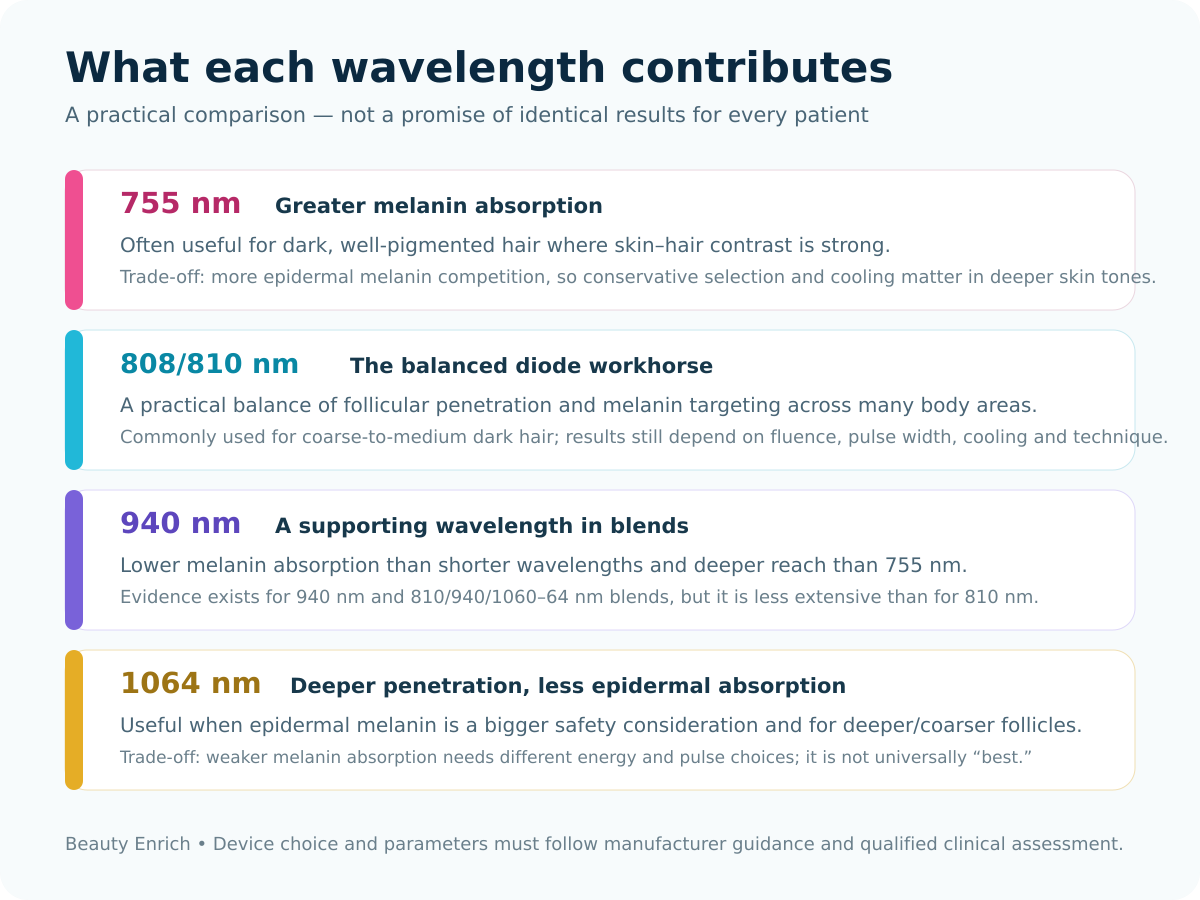
• 755 nm: stronger melanin absorption; useful when the hair is well pigmented and there is good contrast between hair and skin.
• 808/810 nm: a widely used balance of melanin targeting and follicular penetration.
• 940 nm: an intermediate supporting wavelength found in some blended systems; evidence is growing but is less extensive than for 810 nm.
• 1064 nm: deeper penetration with lower epidermal melanin absorption; useful when skin pigment is a larger safety consideration and for deeper, coarse follicles.
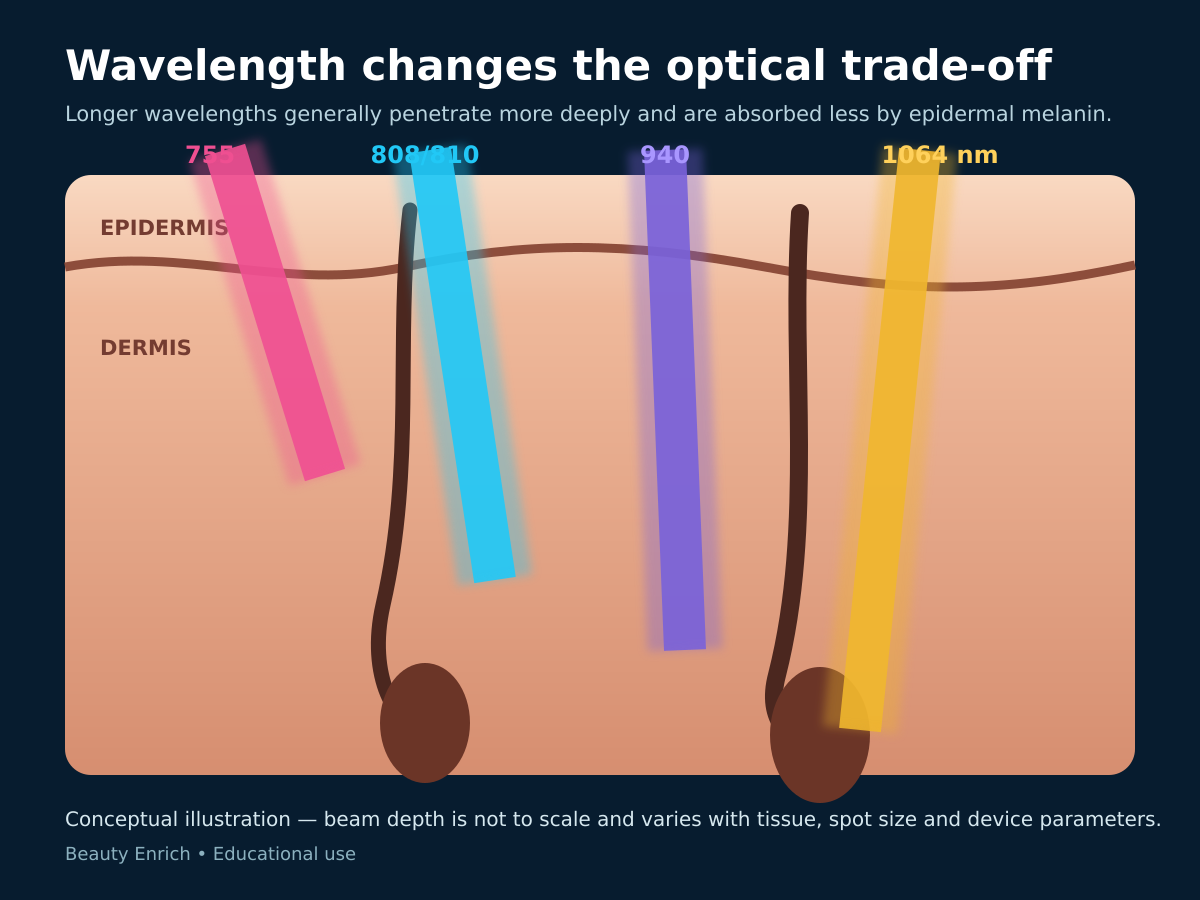
Longer does not automatically mean better. As wavelength increases, penetration generally improves and epidermal melanin absorption falls, but follicular melanin absorption also becomes weaker. Each wavelength therefore has a different optical trade-off.
𝟳𝟱𝟱 𝗻𝗺: 𝘀𝘁𝗿𝗼𝗻𝗴 𝗺𝗲𝗹𝗮𝗻𝗶𝗻 𝗮𝗳𝗳𝗶𝗻𝗶𝘁𝘆
At 755 nm, melanin absorbs light more strongly than it does at the longer wavelengths discussed here. This can make 755 nm effective for dark, clearly pigmented hair, including some finer hairs, when the surrounding skin is relatively light and untanned.
Where it may help:
• Dark hair with strong skin–hair contrast
• Finer but still visibly pigmented hair
• Areas where a strong melanin target is available
The trade-off:
Because epidermal melanin also absorbs more of this shorter wavelength, there is less margin between heating the hair and heating pigmented skin. Deeper skin tones, tanned skin and highly pigmented areas require especially careful assessment, conservative parameters and effective cooling.
Important clarification: a 755 nm diode emitter is not the same laser source as a traditional 755 nm alexandrite laser. They may share a wavelength, but pulse delivery, spot size, beam profile, cooling and power characteristics can differ.
𝟴𝟬𝟴/𝟴𝟭𝟬 𝗻𝗺: 𝘁𝗵𝗲 𝗯𝗮𝗹𝗮𝗻𝗰𝗲𝗱 𝗱𝗶𝗼𝗱𝗲 𝘄𝗼𝗿𝗸𝗵𝗼𝗿𝘀𝗲
The 808–810 nm range is the best-established conventional diode range for hair reduction. It offers a practical balance: good melanin absorption, deeper reach than 755 nm and versatility across many treatment areas.
Where it may help:
• Coarse-to-medium dark hair
• Common areas such as underarms, legs, arms, back, chest and bikini line
• Clinics seeking a versatile core wavelength
Published studies of 805–810 nm systems report meaningful long-term hair-count reduction, including in Indian and mixed-ethnicity populations. However, reported percentages cannot be transferred directly from one device or protocol to another.
Is 808 nm different from 810 nm?
In practice, a two-nanometre label difference should not be used as the deciding factor when buying a machine. Device output, pulse width, spot size, cooling, calibration, handpiece design and clinical protocol are far more important than whether the brochure says 808 or 810 nm.
𝟵𝟰𝟬 𝗻𝗺: 𝗮 𝘀𝘂𝗽𝗽𝗼𝗿𝘁𝗶𝗻𝗴 𝘄𝗮𝘃𝗲𝗹𝗲𝗻𝗴𝘁𝗵
The 940 nm wavelength sits between the classic 810 and 1064 nm ranges. Compared with 755 or 810 nm, it is generally absorbed less by melanin and can reach more deeply. It appears most often as part of a blended 810/940/1060–1064 nm platform rather than as the only wavelength.
Where it may help:
• Broadening a multi-wavelength energy profile
• Protocols for deeper or less strongly pigmented follicles
• Some darker-skin treatment strategies when used with suitable settings and cooling
A small 2003 study explored a long-pulsed 940 nm diode in Asian skin types, and newer studies have examined 810/940/1060–1064 nm blends. Still, the standalone evidence base for 940 nm is smaller than the evidence base for 810 nm.
Claims that 940 nm uniquely “cuts off the blood supply” to every follicle oversimplify the biology. Clinics should judge it as one part of a complete, tested system—not as a magic extra wavelength.
𝟭𝟬𝟲𝟰 𝗻𝗺: 𝗱𝗲𝗲𝗽𝗲𝗿 𝗿𝗲𝗮𝗰𝗵 𝗮𝗻𝗱 𝗹𝗼𝘄𝗲𝗿 𝗲𝗽𝗶𝗱𝗲𝗿𝗺𝗮𝗹 𝗺𝗲𝗹𝗮𝗻𝗶𝗻 𝗮𝗯𝘀𝗼𝗿𝗽𝘁𝗶𝗼𝗻
At 1064 nm, light travels more deeply and is absorbed less by epidermal melanin than shorter wavelengths. This can provide a wider safety margin when treating deeper skin tones, provided the device, settings and cooling are appropriate.
Where it may help:
• Deeper skin tones where epidermal protection is especially important
• Deep, coarse hair follicles
• Highly pigmented body areas that require a cautious optical approach
The trade-off:
Lower melanin absorption can mean less efficient coupling into fine or lightly pigmented hair. The operator may need different fluence and pulse-duration choices rather than simply using the same settings as 755 or 810 nm.
A 1064 nm diode emitter also should not automatically be described as an Nd:YAG laser. Wavelength is only one part of a laser system; source technology and pulse characteristics matter.
𝗗𝗼 𝘁𝗿𝗶𝗽𝗹𝗲- 𝗮𝗻𝗱 𝗾𝘂𝗮𝗱𝗿𝘂𝗽𝗹𝗲-𝘄𝗮𝘃𝗲𝗹𝗲𝗻𝗴𝘁𝗵 𝗺𝗮𝗰𝗵𝗶𝗻𝗲𝘀 𝗴𝗶𝘃𝗲 𝗯𝗲𝘁𝘁𝗲𝗿 𝗿𝗲𝘀𝘂𝗹𝘁𝘀?
They can provide useful versatility, but more wavelengths do not automatically produce more hair reduction.
A multi-wavelength handpiece can distribute energy across different absorption and depth characteristics in one pulse or sequence. That may help a clinic treat a wider mix of hair depths and skin types with one platform. It may also make a protocol less dependent on one optical band.
However, the total delivered energy is shared according to the device's design. A four-wavelength badge does not prove that every wavelength reaches a clinically meaningful output, and it does not replace correct parameters or training.
One small side-by-side pilot study in 14 participants with Fitzpatrick skin types III and IV compared 810 nm with an 810/940/1064 nm blend after three sessions. The blended side showed 12% greater hair reduction at six months, but the authors reported only a 70% confidence level. This is promising, not proof that every blended system will outperform every 810 nm system.
Another study of 23 Asian participants with Fitzpatrick IV–V skin reported an average 66% reduction using a high-power 810/940/1060 nm system for fine, less-pigmented facial hair. Because it was not a head-to-head test of every wavelength and used a specific device and protocol, the percentage should not be treated as a general promise.
𝗛𝗼𝘄 𝗺𝘂𝗰𝗵 𝗱𝗶𝗳𝗳𝗲𝗿𝗲𝗻𝗰𝗲 𝘄𝗶𝗹𝗹 𝘄𝗮𝘃𝗲𝗹𝗲𝗻𝗴𝘁𝗵 𝗺𝗮𝗸𝗲 𝘁𝗼 𝗿𝗲𝘀𝘂𝗹𝘁𝘀?
The honest answer is: sometimes important, but rarely by itself.
Wavelength matters most when it improves the match between a patient's skin, hair and follicle depth. For example, stronger melanin absorption may help well-pigmented fine hair on lighter skin, while lower epidermal absorption may provide a safer working margin for deeper skin tones.
But an appropriately selected 810 nm system can outperform a poorly powered or poorly operated multi-wavelength machine. The factors that usually make the largest practical difference are:
• Accurate skin and hair assessment
• Suitable fluence and pulse duration
• Consistent energy output and calibration
• Adequate epidermal cooling
• Full, even treatment coverage
• Correct session spacing for the body area
• Treating hair in responsive growth phases
• Hormonal conditions and medication history
• Operator training and adherence to the manufacturer's protocol
𝗪𝗵𝗮𝘁 𝘀𝗵𝗼𝘂𝗹𝗱 𝗮 𝗰𝗹𝗶𝗻𝗶𝗰 𝗰𝗵𝗲𝗰𝗸 𝗯𝗲𝗳𝗼𝗿𝗲 𝗯𝘂𝘆𝗶𝗻𝗴?
Do not buy on wavelength count alone. Ask for:
• The verified wavelength mix and energy distribution
• Measured handpiece output, not only the machine's wall-power figure
• Adjustable fluence, pulse-width and repetition-rate ranges
• Stable contact cooling during long sessions
• Suitable spot size and handpiece ergonomics
• Treatment protocols for Indian Fitzpatrick skin types
• Patch-test, adverse-event and eye-protection guidance
• Device-specific training, warranty, service and spare-part support
• Clear regulatory documentation for the exact model
𝗦𝗮𝗳𝗲𝘁𝘆 𝗮𝗻𝗱 𝗿𝗲𝗮𝗹𝗶𝘀𝘁𝗶𝗰 𝗲𝘅𝗽𝗲𝗰𝘁𝗮𝘁𝗶𝗼𝗻𝘀
The correct term is long-term or permanent hair reduction—not guaranteed removal of every hair forever. Multiple sessions are required because only a proportion of follicles are in the most responsive growth phase at one time. Hormonal factors, body area and individual biology can influence regrowth and maintenance needs.
Temporary redness, perifollicular swelling, warmth or tenderness may occur. Burns, blisters, pigment changes and scarring are less common but possible, especially with unsuitable patient selection, excessive settings, poor cooling or incorrect technique. Treatment should be performed only by appropriately qualified, device-trained professionals following local requirements.
𝗧𝗵𝗲 𝗯𝗼𝘁𝘁𝗼𝗺 𝗹𝗶𝗻𝗲
755 nm brings stronger melanin absorption, 808/810 nm offers a proven balance, 940 nm broadens the profile of some blended systems, and 1064 nm provides deeper penetration with lower epidermal melanin absorption. A good multi-wavelength platform can expand treatment flexibility, especially for clinics serving a broad range of Indian skin tones—but wavelength count is only one part of performance.
For clinics, the best machine is the one that combines appropriate optical design with stable output, effective cooling, usable controls, strong training and dependable after-sales support.
Beauty Enrich supplies professional diode laser hair-reduction systems for dermatology clinics, aesthetic practices and trained professionals, with machine guidance, one-year warranty and lifetime support. Explore our diode laser range at https://www.beautyenrich.com/products
This article is for general professional education and does not replace personalised medical advice, device instructions or local regulatory requirements.
𝗘𝘃𝗶𝗱𝗲𝗻𝗰𝗲 𝗿𝗲𝗳𝗲𝗿𝗲𝗻𝗰𝗲𝘀
1. Gold MH et al. Safety and efficacy for hair removal in dark skin types III and IV with a combined 810, 940 and 1064 nm diode laser. J Cosmet Dermatol. 2022. PubMed: https://pubmed.ncbi.nlm.nih.gov/35306725/
2. Marín-García J et al. High-power triple-wavelength diode laser for fine, less-pigmented facial hair on Asian skin. J Cosmet Dermatol. 2024. PubMed: https://pubmed.ncbi.nlm.nih.gov/38348571/
3. Załęska I, Atta-Motte M. Aspects of 805 nm diode laser hair removal safety in a mixed-race group. J Lasers Med Sci. 2019. Full text: https://pmc.ncbi.nlm.nih.gov/articles/PMC6499570/
4. Bencini PL et al. A new long-pulsed 940 nm diode laser used for hair removal in Asian skin types. J Cosmet Laser Ther. 2003. PubMed: https://pubmed.ncbi.nlm.nih.gov/12850801/
5. Vaidya T et al. Laser Hair Removal. StatPearls. NCBI Bookshelf: https://www.ncbi.nlm.nih.gov/books/NBK507861/