LED Phototherapy: A 2026 Buying Guide for Indian Clinics
A practical guide to LED phototherapy: recent acne research, the difference between LED and PDT, Indian buying checks and doctor-led service planning.
Research checked: 27 October 2026. Educational guidance for dermatologists and aesthetic clinic owners.
LED phototherapy is receiving attention as clinics and patients explore non-invasive light-based care. For an Indian clinic, the useful question is which defined patient need a particular device can address, with what evidence and support. A choice of coloured lights on a control panel is not a complete clinical service.
This guide examines a recent acne trial, explains the distinction between LED treatment and photodynamic therapy, and sets out practical buying questions. The proposed service model is doctor-led assessment with appropriate treatment and follow-up. It does not assume that every patient needs light therapy or that adding a machine guarantees revenue.
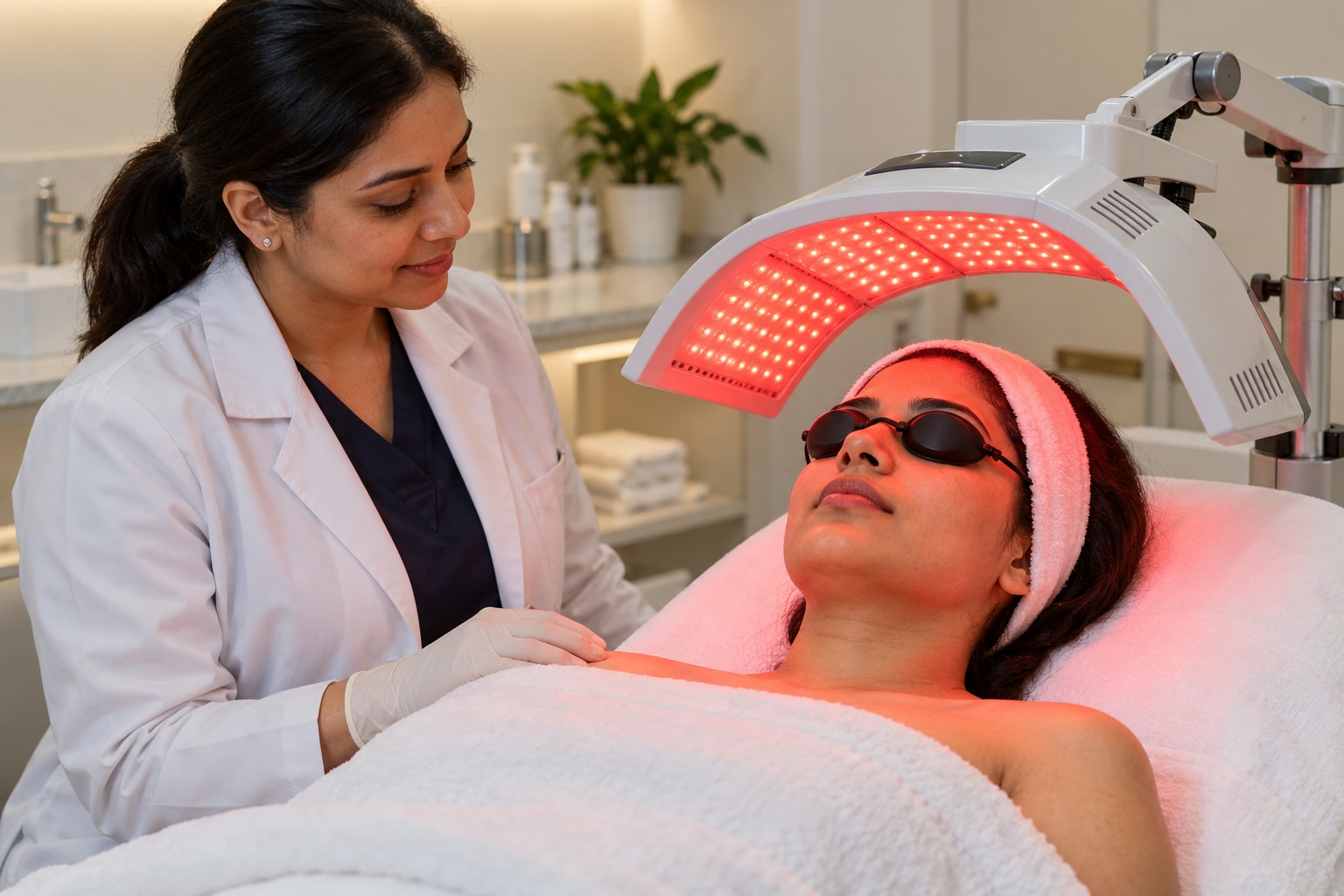
Cover image: AI-generated illustrative scene of a clinician supervising red LED facial treatment with patient eye protection. It is not a photograph of a marketed device, an actual patient or a clinical result.
What does the latest clinical research show?
A randomized, open-label study published in Dermatologic Surgery in July 2026 compared an investigational red-and-blue LED device with a blue-only device for at-home inflammatory acne care. Twenty-three participants completed eight weeks. Both groups had reductions in inflammatory lesions; the study did not find significant between-group differences in lesion-count reductions. The combination group showed a greater change on one investigator assessment. Source: Friedmann and colleagues [1].
The small study and open-label design limit the conclusions. It evaluated particular home-use devices, not every clinic panel or every acne presentation. A clinic should not advertise that combined colours are universally superior, transfer the study's regimen to a different machine or present home-use evidence as proof of a professional system's performance.
The American Academy of Dermatology explains that light-based treatments may be part of an acne plan, but results vary and treatment alone rarely clears acne. It also distinguishes visible-light treatment of pimples from conditions such as nodules and cysts. Source: AAD acne guidance [2].
The theory: light, biological targets and clinical response
LED stands for light-emitting diode. It describes the light source, not a diagnosis or a guaranteed effect. Ask which wavelengths the system emits, what output reaches the treatment area and which intended uses are supported. Colour names alone do not answer those questions.
Laboratory research has investigated blue light interacting with porphyrins produced by the bacterium now known as Cutibacterium acnes. Such mechanistic work helps explain interest in blue-light acne treatment, but laboratory bacterial effects are not a guarantee of clearing a patient's acne. Source: Ashkenazi and colleagues [3].
Red-light treatment is also discussed under photobiomodulation. The AAD describes red or near-infrared treatment as non-invasive and commonly complementary to standard care. It notes that devices and study designs differ and that questions about optimal use remain. Source: AAD red-light guidance [4].
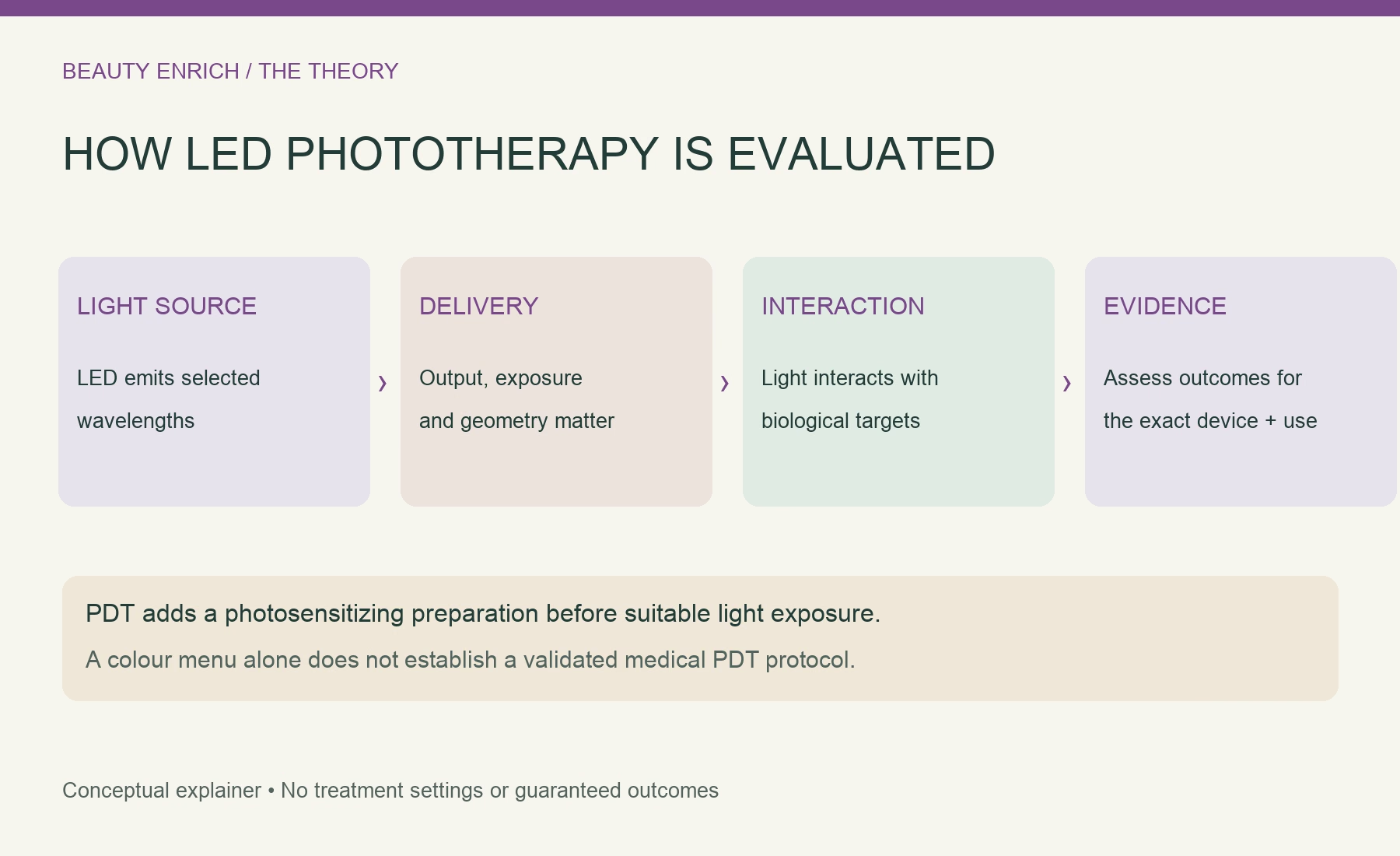
Theory-image caption: LED is a light source; wavelength and delivery conditions influence the exposure. A biological mechanism must still be supported by device-specific clinical evidence. The diagram is conceptual and supplies no treatment settings.
LED phototherapy and PDT are not interchangeable
Photodynamic therapy, or PDT, includes a photosensitizing preparation followed by a suitable light exposure. The AAD describes that additional preparation step in its acne information [2]. A product advertised with the term PDT should not be assumed to provide a complete, validated medical PDT protocol simply because it has coloured LEDs.
Ask the supplier to identify whether the proposed use involves light alone, a separate photosensitizer or another treatment component. Verify the documentation and evidence for the complete intended use. Do not add a photosensitizing product to an LED appointment without an appropriate medical assessment and protocol.
Who might be considered for a clinic service?
The treating doctor should define the condition, goals, alternatives and reason to consider a particular light-based option. A consultation should review relevant medical history, current treatments, light sensitivity and the skin being treated. This guide does not establish suitability for an individual patient.
For Indian practices, request evidence relevant to the patient population rather than assuming identical responses across skin tones. AAD guidance notes that visible-light sensitivity and pigmentation concerns deserve consideration in darker skin. Follow the device's directions, including its specified eye protection, and ensure staff understand the protection required for their role [4].
Avoid offering a universal LED add-on after every procedure. The decision to combine treatments requires its own clinical rationale. Explain uncertainty, possible adverse effects and when the patient should contact the clinic, rather than promising that a non-invasive procedure is risk-free.
What to verify before buying in India
Exact model, intended use and documentation
Obtain the manufacturer, model, configuration and instructions for use. Ask for evidence supporting the claimed indication on that system. CDSCO states that Indian medical devices are regulated under the Drugs and Cosmetics Act and Medical Devices Rules, 2017. Check the applicable documentation for the specific product and intended purpose; seek qualified regulatory advice where needed [5].
An overseas approval claim should be verified against the exact product and authorized indication. Do not treat a brochure logo or a certificate for a different model as sufficient evidence. No device-specific regulatory approval is asserted in this article.
Output information and maintenance
Request technical specifications and an explanation of how output is checked over the equipment's service life. Clarify the stated treatment distance, coverage, maintenance needs and supplied protection. These details belong in the manufacturer's documentation; staff should not improvise a protocol from social-media examples.
Training and operational support
Ask who trains the team and distinguish device operation from clinical decision-making. Establish who assesses patients, records treatment, checks equipment and reviews concerns. Obtain written warranty terms, service coverage, replacement arrangements and any software or support charges.
Build a service around evidence and capacity
A practical introduction begins with a defined indication, a clinician responsible for care and a written workflow. Record baseline findings, explain the plan and arrange appropriate review. Keep photographs comparable if they are used to discuss progress; different lighting should not become a before-and-after claim.
Estimate the complete cost of offering the service. Include the equipment, installation, training, protection, cleaning, room occupancy, staff time, maintenance and follow-up. Decide whether a clinically justified session is included in an existing plan or separately priced, and explain the fee before treatment.
Use the clinic's observed demand to model capacity. Collected service revenue minus variable costs and additional fixed costs provides a planning estimate of contribution. Test lower attendance and downtime scenarios. Avoid a guaranteed payback calculation or claims that a machine will produce a particular monthly income.
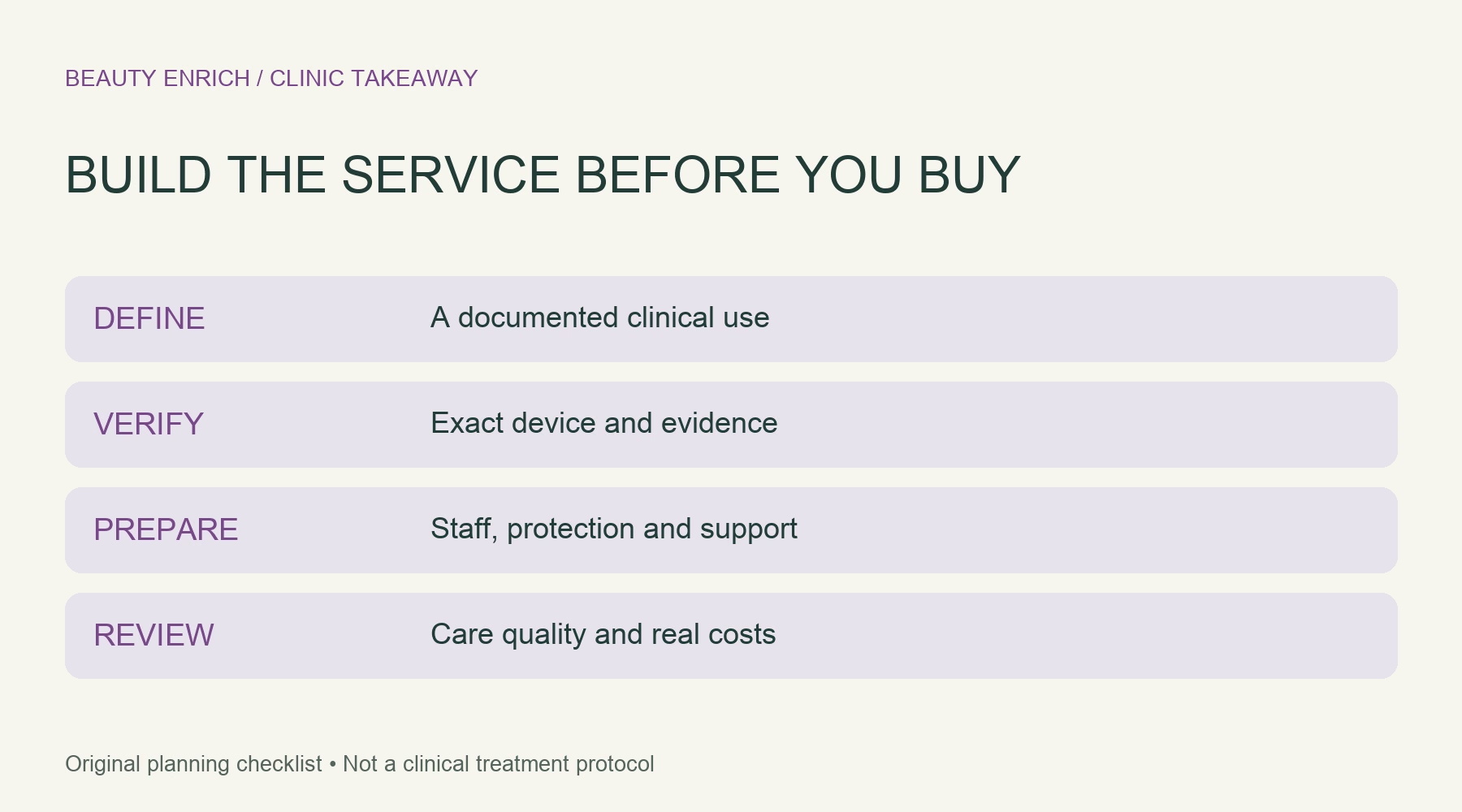
Clinic-takeaway image caption: Define the clinical use, verify evidence, prepare staff and protection, then measure operational usefulness. This is a planning checklist, not a validated treatment protocol.
Beauty Enrich lists a PDT Hydra Facial Machine with LED and Oxygen Care [6]. Its listing can support an initial supplier discussion, but a product name does not establish medical PDT capability or validate every LED claim. Request documentation for the exact function you intend to offer. Our RF microneedling buying guide [7] also explains why training and support should be considered alongside the purchase price.
Frequently asked questions
Is LED treatment the same as a laser procedure?
LED identifies a different light-source technology. Evidence or settings for a laser should not be transferred to an LED system. Compare the exact device, intended use and supporting documentation.
Does more colour choice mean better clinical results?
A colour menu is not clinical evidence. Request the emitted wavelengths, relevant specifications and evidence for each claimed use. A result involving one device cannot establish the performance of another.
Should light therapy replace standard acne care?
A dermatologist should determine the complete plan. The cited AAD guidance describes light-based care as a possible component, with variable results [2]. Patients should not stop prescribed treatment because a device is marketed as an alternative.
Can LED equipment guarantee clinic growth?
No. A useful service depends on clinical suitability, demand, capacity, support and costs. Evaluate those factors before buying, and review the quality of care separately from sales targets.
Sources and related reading
[1] Friedmann et al. Red-and-blue versus blue LED trial, Dermatologic Surgery, July 2026.
https://pubmed.ncbi.nlm.nih.gov/41886698/
[2] AAD: Lasers and lights for acne.
https://www.aad.org/public/diseases/acne/derm-treat/lasers-lights
[3] Ashkenazi et al. Blue light and endogenous bacterial porphyrins, 2003.
https://pubmed.ncbi.nlm.nih.gov/12589953/
[4] AAD: Is red light therapy right for your skin?
https://www.aad.org/public/cosmetic/safety/red-light-therapy
[5] CDSCO: Medical Device and Diagnostics.
https://www.cdsco.gov.in/opencms/opencms/en/Medical-Device-Diagnostics/Medical-Device-Diagnostics/
[6] Beauty Enrich: PDT Hydra Facial Machine with LED and Oxygen Care.
https://www.beautyenrich.com/products/pdt-hydra-facial-hair-regrowth-machine
[7] Beauty Enrich: RF Microneedling Safety Buying Guide.
https://www.beautyenrich.com/blogs/rf-microneedling-safety-indian-clinic-buying-guide-2026