RF Microneedling Safety: A 2026 Indian Clinic Buying Guide
A practical 2026 buying guide for Indian clinics: understand the RF microneedling safety discussion, verify device documents and plan training, support and follow-up.
Research checked: 24 October 2026. For dermatologists, aesthetic doctors and clinic owners.
Buying an RF microneedling machine should begin with a clinical service plan. Who will assess patients? Which indications does the exact device support? Can the clinic provide follow-up and manage complications? These questions are as important as the equipment quotation.
For an Indian practice expanding its services in 2026, the opportunity is to build a well-supported consultation and treatment pathway. The purchase decision should depend on suitable patients, trained clinicians, reliable supplies and documented device claims. A new machine by itself does not establish a competitive or profitable service.
The international safety discussion clinics should understand
On 15 October 2025, the US FDA issued a safety communication about certain uses of RF microneedling. It identified reports of serious complications, including burns, scarring, fat loss, disfigurement and nerve damage. Its page says the agency is evaluating the issue and working with manufacturers. This is an existing communication reviewed for this article, not a newly issued October 2026 warning.
The FDA describes RF microneedling as a medical procedure and advises patients to seek a licensed provider with relevant training and experience. Its communication also points clinicians to device-specific US clearance information. Those records should be checked for the exact device and indication; they do not establish Indian market authorization. Source: FDA safety communication [1].
The American Academy of Dermatology's response on 16 October 2025 emphasized the importance of medical training and knowledge of anatomy. For a clinic owner, the practical implication is to treat operator competence and complication management as part of the investment, rather than optional extras. Source: AAD statement [2].
What makes this different from an ordinary equipment upgrade?
A purchase can be technically successful while the service remains poorly prepared. A demonstration may show how a handpiece operates, but it cannot establish that every patient is suitable or that a particular outcome will occur. Ask the supplier to distinguish operating instruction from clinical training.
Start by defining the problem the clinic intends to address. For example, a doctor may be considering an additional option within a scar consultation service. The clinician should review the diagnosis, alternatives and device-specific evidence before deciding whether RF microneedling has a role. This article does not prescribe treatment settings or establish suitability for an individual patient.
Five checks before choosing an RF microneedling machine
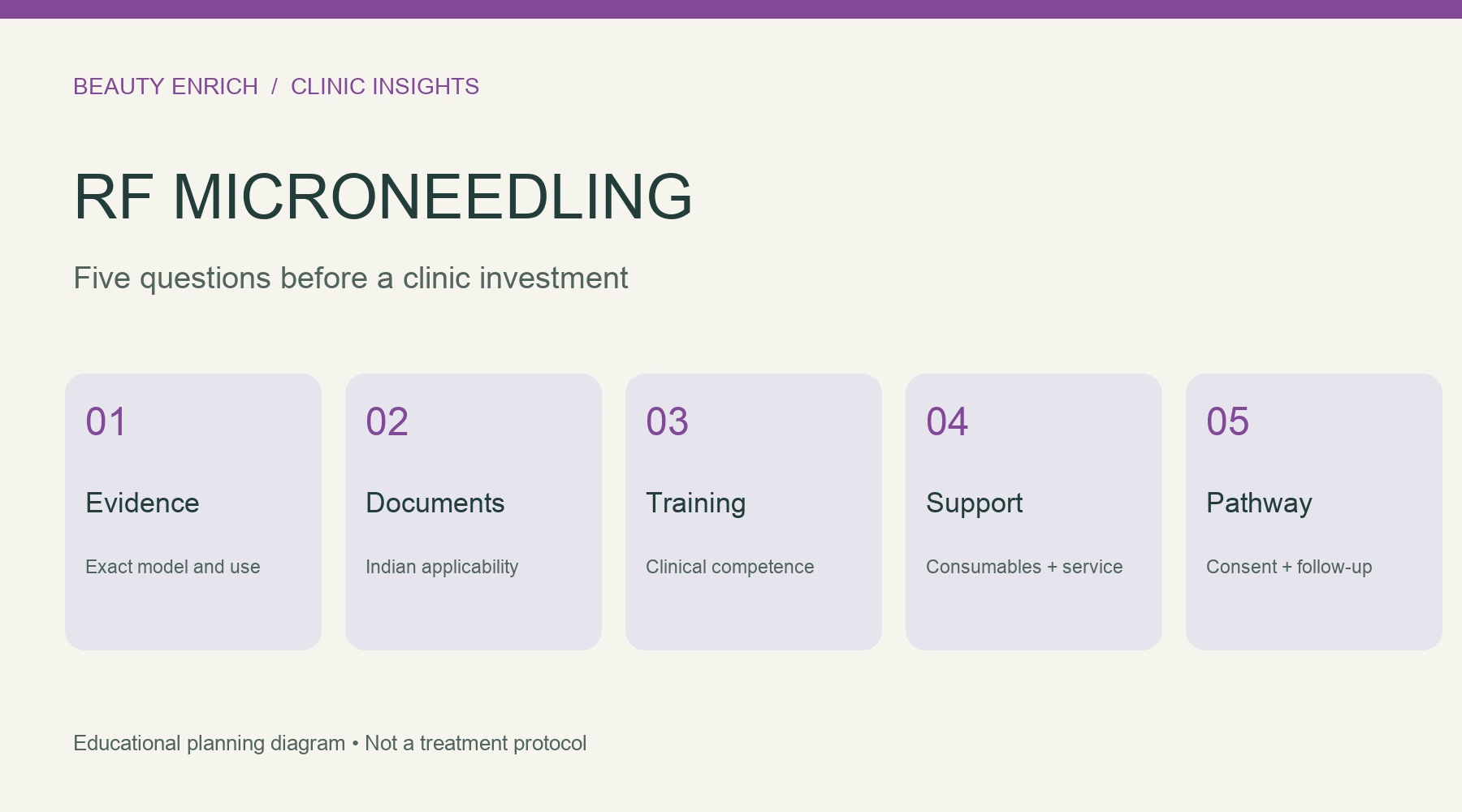
1. Match evidence to the exact device
Request the manufacturer, model, software version where relevant, instructions for use and intended indications. Ask for clinical evidence that actually relates to that system. A study about another device or a broad technology category does not validate every product offered under the same label.
Review the study population, follow-up period, outcomes and reported adverse events. Ask whether skin tones relevant to your practice were represented. Avoid translating a marketing phrase such as minimal downtime into a guarantee for every patient.
2. Verify Indian documentation separately
CDSCO states that medical devices in India are regulated under the Drugs and Cosmetics Act and Medical Devices Rules, 2017. Obtain the documentation relevant to the exact product, manufacturer or importer and intended purpose. Confirm applicability and validity with a qualified regulatory professional when necessary. Source: CDSCO medical device information [3].
Do not assume that an overseas certificate, a supplier's brochure or a registration reference establishes every authorization required in India. Keep the documents with the purchase record and ensure the invoiced model matches the product being supplied.
3. Review training and clinical responsibility
Ask who provides training, what it covers and how competence is assessed. Clarify which staff may prepare the room, assist, operate equipment or make clinical decisions within the applicable professional scope. A certificate of attendance is different from demonstrated clinical competence.
The clinic should identify the doctor responsible for patient assessment, consent, treatment decisions and escalation. Plan for follow-up availability and arrangements when the treating clinician is absent. These are service-design recommendations, not a substitute for professional standards or device instructions.
4. Examine consumables and service support
Request a written list of compatible consumables, their supply arrangements and any storage or handling requirements. Establish how authenticity and packaging integrity will be checked. Follow the manufacturer's instructions for single-use items, cleaning and maintenance.
Discuss warranty exclusions, preventive servicing, response commitments and replacement-part availability. Ask what happens if a handpiece fails during a busy week. Obtain these commitments in writing so the operational comparison extends beyond the purchase price.
5. Check the complete patient pathway
Create a documented process covering assessment, informed consent, procedure records and aftercare communication. Patients should know whom to contact with concerns and how to obtain a timely clinical review. Explain realistic expectations and alternatives, including the option not to proceed.
The clinical team should define its escalation and adverse-event reporting process. Marketing staff should not promise that a technology is universally safe or appropriate for every skin type. Public claims should remain consistent with the product's documented intended use and the clinic's actual capability.
Build a realistic investment model
Compare quotations using the same service assumptions. Include equipment, financing if applicable, installation, staff training, consumables, maintenance, room time and follow-up costs. Reserve capacity for clinical reviews rather than assuming every available slot becomes a paid treatment.
A planning calculation is: monthly service contribution equals collected service revenue minus variable treatment costs and additional fixed operating costs. Include clinician time and the actual local costs your clinic will incur. If considering capital payback, use the complete upfront investment and a positive, realistically estimated monthly contribution.
Test lower demand, equipment downtime and higher consumable costs. These are planning scenarios, not predictions. No purchase quotation or treatment price can guarantee demand, clinical results or return on investment.
Add a service in stages
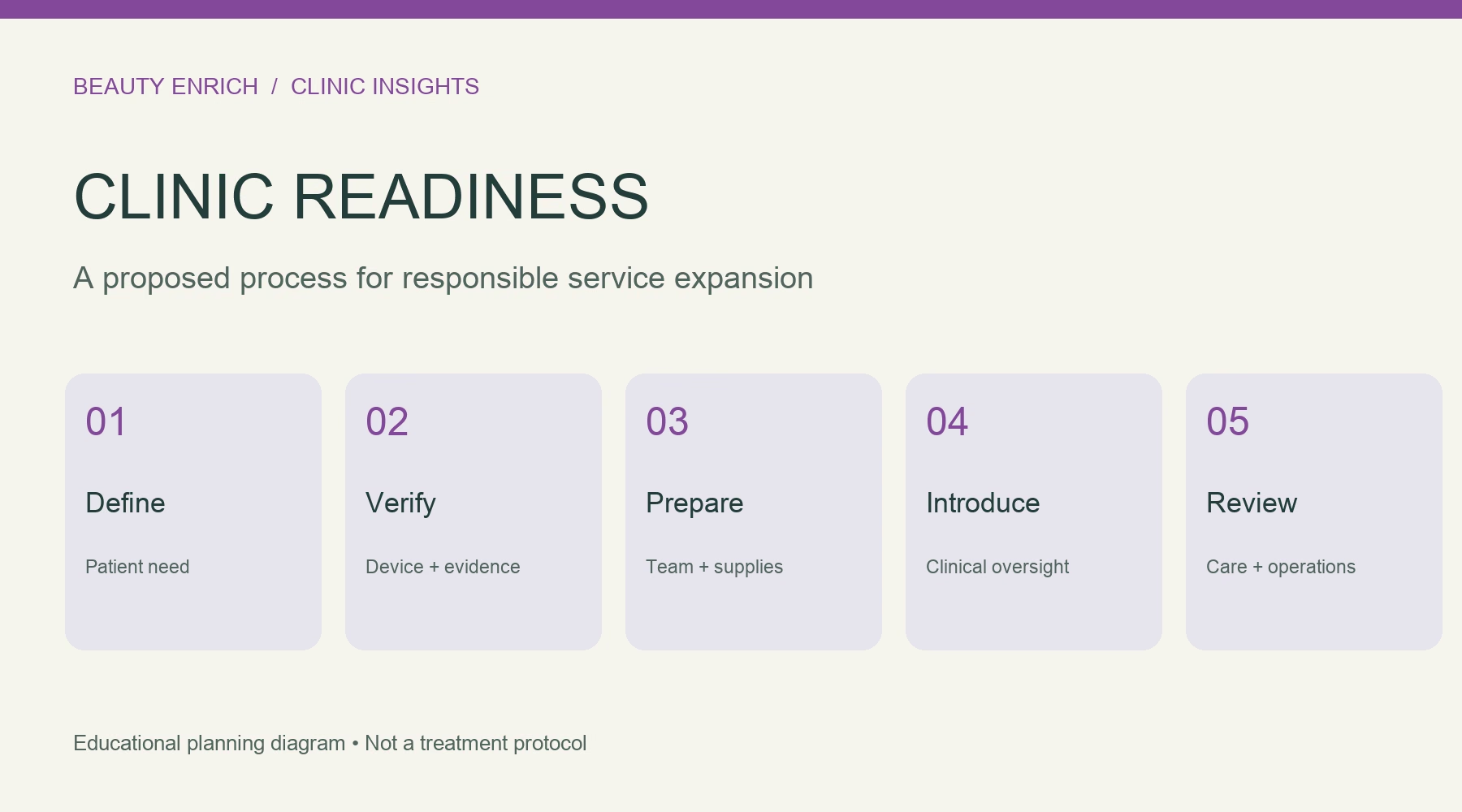
Begin with a readiness review and a clearly defined clinical use, followed by appropriate training and a limited operational introduction. Audit the completeness of consent and treatment records, patient understanding, follow-up workload and equipment reliability. Review clinical concerns separately from sales targets.
Beauty Enrich's guide to how an MNRF machine works [4] provides introductory background. Its CO2 fractional laser versus MNRF comparison [5] can support an initial discussion about different technology categories. Neither replaces a doctor-led assessment or a review of the exact device's documentation. Explore the equipment catalogue [6] and request a model-specific demonstration before committing.
Frequently asked questions
Does the FDA communication mean every RF microneedling device is banned?
The cited communication describes risks and an ongoing evaluation; it does not announce a blanket ban. Verify the current status and authorized uses of the exact device rather than relying on general advertising claims. See source [1].
Can a clinic copy settings from another machine?
A clinic should follow the exact device's instructions and relevant professional training. This buying guide provides no transferable treatment parameters. The treating doctor must determine the clinical plan within their competence and applicable requirements.
Is RF microneedling the right next purchase for every clinic?
No universal recommendation follows from a technology trend. Evaluate patient needs, existing services, clinician capability, documentation, support and costs. If any essential part is missing, resolve it before offering the procedure.
What should a supplier demonstration establish?
It should help the clinic understand the system, documented claims, consumable requirements, workflow and support arrangements. It should not be treated as proof of guaranteed outcomes or a substitute for clinical evidence.
Sources and further reading
[1] FDA: Potential Risks with Certain Uses of RF Microneedling, issued 15 October 2025.
https://www.fda.gov/medical-devices/safety-communications/potential-risks-certain-uses-radiofrequency-rf-microneedling-fda-safety-communication
[2] American Academy of Dermatology statement, 16 October 2025.
https://www.aad.org/news/statement-on-fda-rf-microneedling-risks
[3] CDSCO: Medical Device and Diagnostics information.
https://www.cdsco.gov.in/opencms/opencms/en/Medical-Device-Diagnostics/Medical-Device-Diagnostics/
[4] Beauty Enrich: How Does an MNRF Machine Work?
https://www.beautyenrich.com/blogs/how-mnrf-machine-works-treatment-aftercare
[5] Beauty Enrich: CO2 Fractional Laser vs MNRF Machine.
https://www.beautyenrich.com/blogs/co2-fractional-laser-vs-mnrf-machine
[6] Beauty Enrich equipment catalogue.
https://www.beautyenrich.com/products
Image captions: The cover presents five procurement questions. The second image maps a proposed clinic readiness process. Both are original educational diagrams, not device photographs, clinical evidence or validated treatment protocols.